
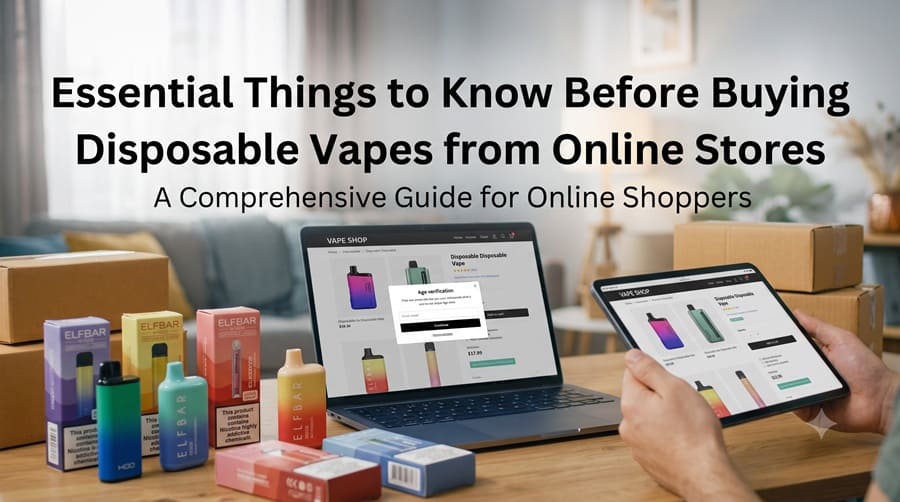
Buying Disposable Vapes Online in Canada: 7 Things to Check Before You Order
Cannabis Near Me Editorial Team
September 29, 2026

By Cannabis Near Me Editorial Team | Last reviewed: September 29, 2026
Quick answer: Puff counts, nicotine strength, packaging, age rules and retailer policies all matter when comparing disposable vapes online. In Canada, legal nicotine vaping products sold to consumers must meet federal requirements, including a maximum nicotine concentration of 20 mg/mL, prescribed labelling and—generally—an excise stamp. Provincial and territorial rules can add stricter age, flavour, retail and delivery requirements.
Important: Vaping products containing nicotine are addictive and are not intended for youth or people who do not use nicotine. This article is consumer information, not medical or legal advice.
A disposable vape may be marketed with a specific puff count, but that figure should be read as an estimate produced under particular testing conditions. Real-world results can change with draw length, how often the device is used, battery performance, airflow, coil behaviour and the amount of liquid that actually reaches the coil.
That is why an unsupported rule such as “a 3,500-puff device will really deliver about 2,000” is not reliable across products. A better comparison is to look at the device’s liquid capacity, battery specification, manufacturer information and independent user reports, while remembering that none of those makes an exact puff total certain.
In Canada, the Nicotine Concentration in Vaping Products Regulations set a maximum nicotine concentration of 20 mg/mL for vaping products manufactured or imported for sale. A package displaying a nicotine concentration above 20 mg/mL should therefore be a warning sign for a product being offered for the Canadian market.
Two products with the same labelled nicotine concentration can still feel different in use. Device power, coil design, airflow and whether the formulation uses nicotine salts or freebase nicotine can affect aerosol production and perceived delivery. The label tells you concentration; it does not guarantee an identical experience from one device to another.
For Canadian consumers, packaging provides more useful verification than marketing copy. Health Canada states that legal vaping products with nicotine at 0.1 mg/mL or more must use child-resistant packaging. Required labelling includes ingredients, nicotine concentration, toxicity information and a nicotine health warning in English and French.
The Canada Revenue Agency also requires excise stamps on most packaged vaping products sold in Canada. The stamp is intended to show that applicable vaping duty has been paid. For online orders, the appropriate stamp may depend on the province or territory where the consumer resides.
Federal law sets a minimum baseline for youth access, but provinces and territories may impose higher minimum ages and additional restrictions on flavours, retail locations, promotion and sales. Before ordering, check the rules that apply where the product will be delivered rather than assuming that a retailer’s website reflects every local requirement.
Online age checks also matter. A site that treats an age-restricted nicotine product like an ordinary low-risk retail item deserves closer scrutiny. Delivery and identity-verification requirements can differ by jurisdiction and by retailer.
Counterfeit and contraband vaping products can look convincing in listing photos. A low price alone does not establish that a product is fake, and a polished website does not establish that it is genuine. Check for required Canadian labelling, the excise stamp where required, manufacturer or distributor information, intact packaging and any brand-specific authentication method.
The CRA advises consumers not to buy or use packaged vaping products that should carry an excise stamp but do not. That is a stronger verification point than vague claims such as “premium,” “authentic,” or “direct from supplier.”
Disposable devices can arrive damaged, leak in transit or fail shortly after opening. Before ordering, find out how the retailer handles a device that is dead on arrival, what evidence is required, how quickly a problem must be reported, and whether opened consumable products are excluded from ordinary returns.
When comparing any vape store online, treat clear policies, mandatory product information and age controls as verification points—not as proof that one retailer is automatically better than another. A trustworthy policy should be specific enough that you know what happens if the order arrives damaged, incorrect or unusable.
Disposable vapes combine a battery, electronics and liquid in a small enclosure. Do not use a device that is visibly damaged, swollen, leaking, unusually hot or otherwise defective. Follow the manufacturer’s storage instructions and keep nicotine products away from children and pets.
Do not put a disposable vape into ordinary household recycling if local rules treat it as battery or electronic waste. Municipal collection rules differ, so check your local household hazardous-waste or e-waste guidance.
Canadian federal law regulates vaping products and restricts youth access, while provinces and territories can add stricter rules. There is no single Canada-wide answer that replaces local requirements, so an adult buyer should check the rules in the destination province or territory and use a retailer that follows applicable age-verification and product rules.
No. Health Canada’s nicotine concentration regulations set a maximum of 20 mg/mL for vaping products manufactured or imported for sale in Canada.
Look for Canadian-compliant labelling, the required nicotine and hazard information, child-resistant packaging where applicable, and the vaping excise stamp required on most packaged vaping products sold to consumers. Provincial requirements can add further conditions.
No. Puff count is an estimate. Actual use varies with draw length, frequency, device design, battery performance and other factors.
Stop using a device that appears unsafe or damaged and follow the retailer’s documented fault or replacement process. Keep the packaging and order information because the seller may require photos, batch details or other proof.
Buying disposable vapes online is easier to evaluate when you separate measurable compliance signals from sales language. Puff count is an estimate, nicotine concentration has a legal ceiling in Canada, packaging and excise stamps matter, and local age and product rules can be stricter than the federal baseline. A careful buyer should verify those points before comparing flavour, price or convenience.
This article summarizes general consumer-safety and regulatory information available as of September 29, 2026. Vaping laws can change, and provinces, territories and municipalities may impose rules that are stricter than the federal baseline. Readers should verify current requirements with the appropriate government authority. This content is not legal or medical advice and does not encourage nicotine use by non-users or youth.