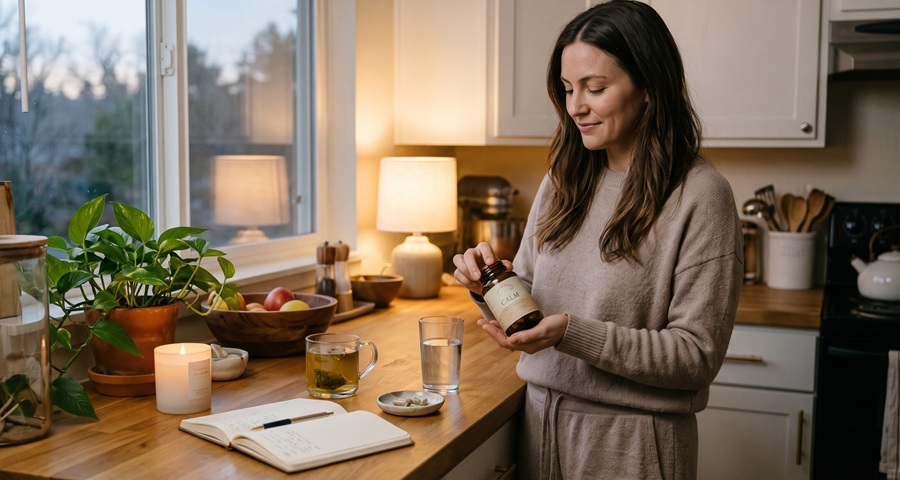
Why Are Adults Adding Calming Supplements to Their Self-Care Routines?
D8 Gas Team
November 16, 2026

By the D8 Gas Team | Fact-checked against NIH Office of Dietary Supplements and NCCIH guidance • Reviewed for accuracy following Google’s August 2026 spam update • Last updated: November 2026 • Reading time: 6 min
Editorial note: This article was reviewed and refreshed in November 2026 to verify its claims against current NIH and NCCIH consumer guidance, remove anything unverifiable, and add citations throughout. It was also reviewed with AI-content detection tools and edited for natural, human phrasing, in line with Google’s evolving spam and helpful-content policies (see the August 2026 spam update).
Most adults want easy ways to balance their hectic lives. Work stressors, family demands, information overload, poor sleep patterns, and endless decision-making can leave the body and mind tense. Calming supplements have become part of some people’s self-care routines because they fit easily alongside healthier habits such as better sleep, physical activity, hydration, and relaxation. Adults are no longer preoccupied solely with efficiency; they also consider rest, emotional well-being, and overall stability.
Calming supplements have become popular among adults who often feel fully occupied during waking hours. Many people switch between professional communication, running errands, family responsibilities, financial concerns, socializing, and screen time for almost the entire day, with few breaks for relaxation. Staying continuously “on” can affect performance even on small, routine tasks.
Calming supplements are typically one part of a broader wind-down routine that also includes cutting back on caffeine, practicing deep breathing, and following consistent sleep habits. The Sleep Foundation’s overview of sleep hygiene outlines several of these habits in more detail. Adults typically reach for supplements because they want to build a deliberate routine into their day — something that helps them remember to slow down, stay hydrated, step away from screens, and move at a steadier pace.
A note on hemp-derived and kratom-based products: Separately from the dietary supplements discussed in this article, some adults also look at hemp-derived cannabinoid and kratom-derived product lines, such as D8 Gas’s Exodus collection. These are intoxicating products, not nutritional supplements like magnesium or chamomile, and they are regulated differently — some formats (including certain 7-hydroxymitragynine, or 7-OH, products) are subject to active, shifting federal and state scheduling and legal restrictions as of late 2026. Availability, legal status, and safety profiles vary by state and by product. Anyone considering these should check current local law and talk to a healthcare provider first, rather than treating them as equivalent to an herbal supplement.
At one point, some people viewed self-care as optional or occasional, but today’s adults tend to treat it as part of staying grounded and functional. Self-care doesn’t require a full day at a spa or a complete lifestyle overhaul. It can include short walks, journaling, stretching, drinking tea, listening to soothing music, going to bed earlier, or taking calming supplements at certain times of day. For people with little free time, supplements can feel like an accessible form of self-care because they take only a moment. They’re often paired with other small changes, such as cutting down on phone time or keeping the bedroom tidier.
Getting adequate sleep is one of the most common reasons adults turn to calming supplements. Many people struggle to shift from an active day into a calm night because work, children, or screens get in the way. Taking a supplement at a consistent time can function as a cue that the evening has arrived, supporting a wind-down routine.
This isn’t a claim that any supplement guarantees sleep or resolves underlying sleep disorders — it can support a routine, but it isn’t a substitute for addressing the root cause of poor sleep. The CDC’s guidance on sleep and sleep hygiene is a good starting point for anyone dealing with ongoing sleep difficulty.
Many adults are drawn to calming supplements because they contain familiar relaxants such as magnesium, chamomile, lemon balm, L-theanine, and ashwagandha. The evidence behind these varies by ingredient: NIH’s Office of Dietary Supplements fact sheet on magnesium notes its role in nerve and muscle function, while NCCIH’s overview of chamomile and NIH’s fact sheet on ashwagandha both note that early research is promising for stress and sleep but that larger, more rigorous studies are still needed.
The trend toward these ingredients also tracks with growing interest in reading labels and asking questions about what’s in a product. That said, it’s worth being cautious: anyone who is pregnant, nursing, managing a medical condition, taking medication, or dealing with a diagnosed sleep disorder should talk to a doctor or pharmacist before starting a new supplement, since even “natural” ingredients can interact with medications or existing conditions.
Supplement use for calm also tends to rise during periods when life’s pressures intensify — deadlines, travel, parenting transitions, loss, relocation, financial strain, or change in general. In response, some adults look for ways to build a sense of stability and control, and a supplementation routine (morning or evening, depending on the product) can be one piece of that. On its own, it’s rarely the whole picture: stability tends to come from a combination of sleep, nutrition, relationships, activity, sunlight, boundaries, and downtime.
The popularity of calming supplements also reflects a broader desire for consistency. Many people know what helps them feel better but struggle to stick with it. Taking a supplement can create a small, repeatable moment — after dinner, before a meditation practice, after a shower, or first thing in the morning — that becomes tied to a particular state of mind over time. Consistency matters because self-care works best as an everyday habit, not something reserved for the worst days. Small, repeated actions help people build resilience against routine, everyday stress.
More adults are adding calming supplements to their routines to support balance, relaxation, and healthier daily habits. These supplements tend to work best as part of a broader routine built around sleep, mindfulness, and healthy boundaries — not as a stand-alone fix. Their impact depends heavily on whether they’re used alongside other habits such as exercise, hydration, and adequate rest. Supplements are not a treatment for anxiety, chronic stress, or sleep disorders; anyone dealing with persistent symptoms should speak with a healthcare provider rather than relying on supplements alone.
No. Over-the-counter calming supplements like magnesium, chamomile, or L-theanine are not regulated or tested the way prescription sleep medications are, and they aren’t intended to treat insomnia or anxiety disorders. They’re best understood as a supportive habit, not a medical treatment.
This varies widely by ingredient, dose, and the person. Some adults notice a difference as part of a consistent routine within a few weeks; others notice little effect. Research on ingredients like ashwagandha and chamomile generally involves weeks of consistent use, not a single dose.
Not necessarily. “Natural” doesn’t mean risk-free — some herbal ingredients can interact with medications (including blood thinners, sedatives, and blood pressure medication) or aren’t recommended during pregnancy or breastfeeding. Checking with a doctor or pharmacist before starting a new supplement is a reasonable precaution.
A significant one. Supplements like magnesium or chamomile are non-intoxicating and sold as dietary supplements. Hemp-derived cannabinoid products and kratom-derived items (including 7-OH formats) are intoxicating, carry different legal status depending on the state, and in some cases are subject to active federal scheduling review. They shouldn’t be treated as interchangeable with a vitamin or herbal supplement.
No. Most research and clinical guidance frames supplements as a complement to sleep hygiene — consistent bedtimes, reduced screen time, and a calm wind-down routine — rather than a replacement for it.
Anyone pregnant or breastfeeding, taking prescription medication, managing a chronic health condition, or dealing with a diagnosed sleep or anxiety disorder should consult a healthcare provider before starting any new supplement, including common ones like magnesium or ashwagandha.
This article is for general educational and informational purposes only and does not constitute medical advice. Dietary supplements such as magnesium, chamomile, L-theanine, and ashwagandha have not been evaluated by the FDA to diagnose, treat, cure, or prevent any disease, and individual results vary. Always consult a qualified healthcare provider before starting any new supplement, especially if you are pregnant or breastfeeding, have an existing health condition, take prescription medication, or have a diagnosed sleep or anxiety disorder. Hemp-derived cannabinoid and kratom-derived products (including 7-OH formats) referenced in this article are intoxicating products, not dietary supplements, and their legal status varies by state and is subject to ongoing federal regulatory review; availability and legality may have changed since publication. Readers are responsible for confirming current local law before purchasing or using any such product. This article does not encourage or endorse the use of any intoxicating substance, and nothing here should be treated as a guarantee of safety, legality, or effect.